This small air bladder is from a feather boa kelp. Air bladders (of varying sizes) are particular to the brown algae family; they are instrumental in keeping the seaweed blades closer to the surface for better access to light and thus better ability to photosynthesize. Isn't it adorable!
Monday, May 17, 2010
Tuesday, May 11, 2010
Acid Kelp, Princeton-by-the-Sea April 21, tide: -.03
It felt like a hurricane on the beach today. The onshore wind worked fiercely against the small waves, which had a hard time coming in to meet the shore. A large flock of geese would rise and group, but making no headway would come down and stand at the waters edge making a fuss, bill into the wind. It was low tide and large clumps of dark seaweed were distributed in batches all over the sand, wrenched from their underwater world and left on the beach. Individual bits would occasionally blow off from a clump and tumble towards the water. Unlike a shell or sand dollar or smooth piece of driftwood, these clumps of organic matter were not inviting--they were dark, sticky and tangled.
But I was here to collect this seaweed, not stones or shells or driftwood. I dutifully inspected each clump and was astonished at the variety I found. Although I could only affirm basic distinctions amidst the jumble, there were clearly an astonishing array of algae tangled together: some smooth, some bumpy, some bright green, most reddish brown, some frilly and some simple and flat with remarkable shapes. I dumped a few clumps into my cooler bag. There was one in particular that I had an inkling was long and spikey but it was a tangle of dark green strands so I dumped it in with the others.
At home I separated out each sample seaweed, rinsed it under the tap and dropped it into a tub of salt water. As soon as it hit the water, its rightful medium, it came to life--its form and color and translucent sensuality awakened. Pale pinks with textures mingled with bright greens and yellow oranges. I found the green spikey and after rinsing it I tried to lay it out flat and find its form.. As I tried to tease out the delicate blades I experienced immense frustration. Each blade would stick to my fingers or to each other. These ocean flora truly belong in water not air. But my amazement grew as I persevered; the seemingly delicate connections between each razor-thin blade were powerfully strong and able to withstand immense force, and each blade had the serrated edges that engendered the blades themselves. While many seaweed blades clearly break easily at the ends, these were usually intact and fully shaped when I could unravel them. I truly felt like I was unravelling a secret that few have seen before: the secret of Desmarestia ligulata or acid kelp.
The Beach Book is Out
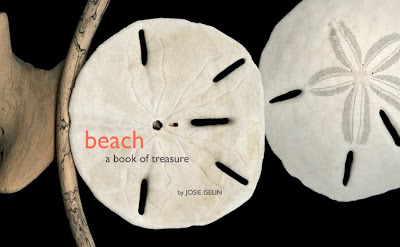
The Beach Book is officially out. There was a nice event at ZincDetails the other night and Beach: A Book of Treasure was on its pedestal amongst the other fun Chronicle books in a month long Pop-up Shop. The books fill the entry before you continue into the wonderland of Marimekko and other design-y and irresistible home objects in the Fillmore Street shop. There are three prints up on the walls including the blue seaglass and all fit well. The anticipation of summer is palpable.
I am looking forward to upcoming events, going to the beach as often as possible and thinking about how art and science dovetail there. Putting talks together is an opportunity to re-visit the imagery and make new connections. Bits and pieces of my thoughts will come up here.
Andrew made cinnamon buns for Mothers Day. They were divine.
Wednesday, February 10, 2010
A Walk in the Canyon
After a couple of warmish days the pussy willows were a delicate cloud of white buds inviting closer inspection. Depending on their orientation to the brief moments of sun we have had over the past week, the buds are either in full fuzz or just emerging.
Monday, February 1, 2010
These are some tumbled seamarbles. The collection pic was sent by avid beach wanderers Kim and Dave who are lucky enough to live in Hawaii near the beach. Kim's theory on the marbles is: "The elementary school is on the other side of the highway, then nothing but beach on the beach side. There are a few underground drains that flow into the ocean by the school. So, we think, based on the kind of marbles they are, that they are from way back in the day...kids playing marbles on the playground. I only find them certain times when the sand is all washed away and the rock piles are what's left. This past year, it was only one time that those rocks were exposed."
What wonderful anthropological wrack combing.
Labels:
beach,
beachcombing,
Hawaii,
marbles,
Sea glass
Wednesday, January 27, 2010
Andrew's Favorite
This is Andrew's favorite. All of these scallops are from the Outer Banks of North Carolina (thank you Sharon Gilchrest O'Neill). The tiny ribbed clam is from Pawley's Island, South Carolina. I talk about sorting and how sorting builds the fundamental skills of science--observing, comparing organizing classifying. But "how we choose which objects to group together is ultimately a creative act, the work of the artist. The beach becomes the locus of art and science to dance together, to intermingle and connect."This is all hard to think about when the dire news from the school district came out today about the drastic budget cuts heading our way. Superintendent Garcia also wrote an impassioned editorial in our Chronicle which was well spoken. I am working with a great group of Lowell parents working to raise awareness and raise much needed funds to supplement the decimated school budget next year. I had a thought today: Public school is no longer free. It is ridiculously cheap, but our legislatures and state governments are telling us that it is no longer free. We MUST put something into the pot to keep it alive. It might be $20 or $200 or $2,000, but it is not free. This is a sad state of affairs.
Thursday, January 14, 2010
A New Book
I received two advanced copies of my new book yesterday afternoon. I happened to be home when the FedEx guy knocked at the door. I opened the yellow manila envelope and there was the book, a foreign object to me, the author who had slaved over each image, cut out cardboard to determine trim size and worked and reworked every aspect of the text, photographs and design of the book.
The book, a real book, is an amazing thing and until you hold it in your hands, you cannot really approximate what it will be like. It is a great and surprising moment.
My book, Beach: A Book of Treasure, is 7” high and 11” wide. Despite all my Indesign and Photoshop and pdf files, with their ever present rulers, I can only truly feel these dimensions now with the book in hand. The added length of the page (from my previous books) gives a delightful heft to the 144 pages as you flip through from front to back. The blue case color and the soft beige endpapers are cheery and soothing--something we could not be totally sure of despite the back and forths and changing and choosing of color chip--until the book is in hand.
So now the book and I are getting to know each other all over again (I feel like a Sesame Street character) but its true.
The best endorsement of the book to me so far is that Andrew (age 12) came home tired and hungry yesterday evening, but on seeing the book sitting on the entry table had to go through the entire thing, clearly captivated, before even coming to the dinner table. He then went through the entire book again after dinner. His favorite page is a spread late in the book of a mass of grey-ribbed scallops with a single, small, white clam shell for contrast.
What more could I want from a book?
Subscribe to:
Posts (Atom)


